ReviewedEducational article · Updated Oct 2026
Key takeaways
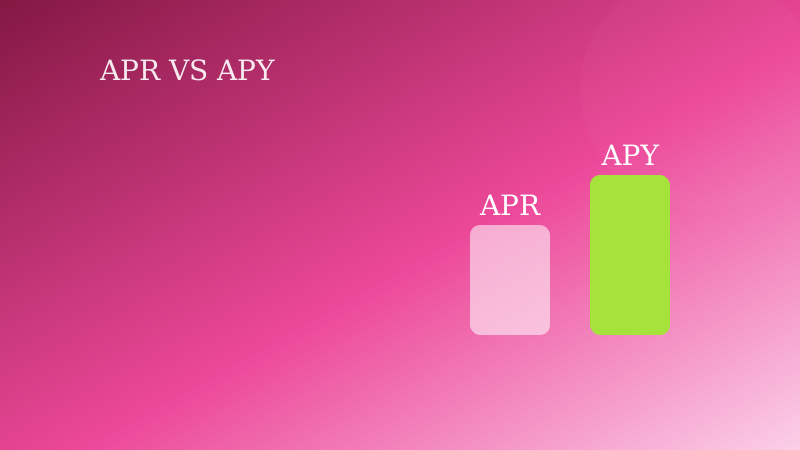
- APR is the stated yearly rate; APY includes the effect of compounding within the year.
- For savings, a higher APY at the same APR means more frequent compounding.
- For loans, APR often includes certain fees and is meant to show total yearly cost.
- Compare like with like: APY with APY, APR with APR.
Open any savings account page and you will see an APY. Open any loan or credit card offer and you will see an APR. The two abbreviations differ by one letter, and they are easy to confuse, but they answer slightly different questions. Understanding them helps you compare offers properly.
What APR means
APR stands for annual percentage rate. It is a yearly rate that does not include the effect of compounding within the year. If a credit card charges 18% APR, interest is typically calculated at a smaller periodic rate (for monthly billing, 18% ÷ 12 = 1.5% per month) and added to the balance, so what you effectively pay over a year is somewhat more than 18% if you carry the balance.
For loans, regulators in many countries require lenders to quote an APR that also reflects certain mandatory fees, so that borrowers can compare offers. The exact rules differ by country, so check what your local APR includes.
What APY means
APY stands for annual percentage yield. It tells you what you actually earn in one year after compounding, assuming you leave the interest in the account. The formula is APY = (1 + APR ÷ m)m − 1, where m is the number of compounding periods per year.
How compounding frequency changes the yield
At a 5% stated rate, the effective annual yield depends on how often interest is added:
- Compounded annually: 5.000%
- Compounded monthly: 5.116%
- Compounded daily: 5.127%
On $10,000, monthly compounding earns about $511.62 in a year, compared with $500 for annual compounding. The extra $11.62 is interest earned on interest within the year.
The effect grows with the rate
At a low rate, the difference is tiny: a 2% rate compounded monthly gives an APY of 2.018%. At a high rate, it is more noticeable: a 12% rate compounded monthly gives an APY of 12.683%, and compounded daily about 12.747%. This is one reason high-interest debt such as credit card balances grows faster than the headline APR suggests.
A 12% APR compounded monthly costs about 12.68% over a full year if the balance is left untouched.
Savings versus borrowing
- When saving, a higher APY is better. Compare APYs between accounts, because they already include compounding.
- When borrowing, a lower APR is better. Compare APRs, and also look at fees and the total repayment amount, because APR is only part of the picture.
Why the confusion causes trouble
Marketing often quotes the number that looks best. A savings product may advertise the APY because it is a bit higher than the APR. A card may advertise the APR because it looks lower than the effective cost. Neither is dishonest, but comparing a savings account’s APY with another’s APR would give a misleading result.
A quick checklist
- Check whether the number quoted is an APR or an APY.
- If it is an APR on savings, convert it to APY using the compounding frequency.
- If it is an APY on a loan (rare), convert it back to the periodic rate to compare with APRs.
- For loans, look at the total cost in currency, not just the percentage. See how to read a loan offer.
Common questions
Is APY always higher than APR?
If interest compounds more than once a year, yes. If compounding is annual, they are equal.
Does APY include fees?
Not usually for savings products. Monthly maintenance fees, minimum balance requirements and withdrawal limits can reduce the real yield, so read the account terms.
Where can I try the numbers?
The compound interest calculator shows the effect of compounding on a balance over any horizon. For the mechanism behind this, read how compound interest works and simple vs. compound interest.
Common mistakes to avoid
- Comparing APY on one product with APR on another. Convert them to the same basis first.
- Ignoring fees and minimum balances that reduce the effective yield on savings.
- Assuming a 0% intro rate lasts forever on credit offers; check when it ends.
- Thinking a small difference in APY is trivial over many years; compounding magnifies it.
Quick glossary
- APR
- Annual percentage rate; the yearly rate without in-year compounding.
- APY
- Annual percentage yield; the effective yearly rate including compounding.
- Periodic rate
- The rate applied each period, such as APR ÷ 12 for monthly.
- Compounding frequency
- How often interest is added to the balance.
Try it yourself
Take a 6% APR and compute the APY for annual, monthly and daily compounding using (1 + APR ÷ m)m − 1. Notice how little the frequency changes the answer compared with changing the rate itself.
Further reading from official sources
These are general educational resources. Rules and figures differ by country, so look for your own country’s equivalent.
Related reading
This article is for general educational purposes only and is not financial advice. Examples use simplified, hypothetical numbers and ignore taxes, fees and personal circumstances. Consider speaking with a qualified professional before making financial decisions. See our full disclaimer.