ReviewedEducational article · Updated Oct 2026
Key takeaways
- Simple interest is calculated only on the original principal.
- Compound interest is calculated on principal plus previously earned interest.
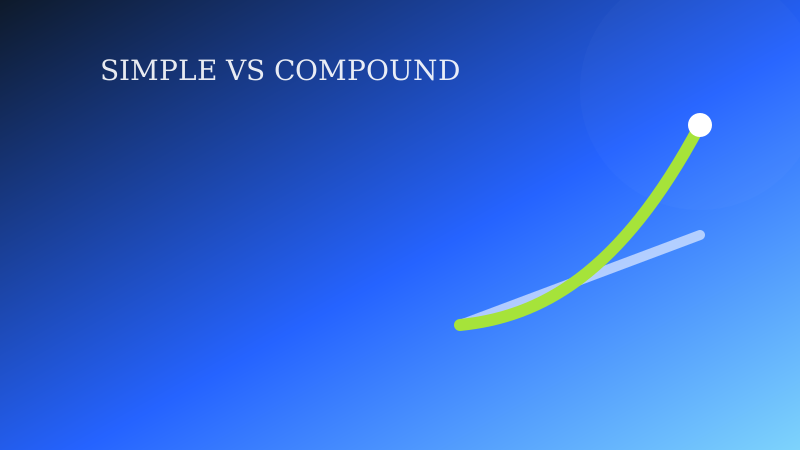
- The gap is small in the first years and very large over decades.
- The same logic applies to debt: compounding works against borrowers.
Interest is the price of using money. The two common ways of calculating it, simple and compound, give identical results in year one and wildly different results later. Understanding the difference helps you read savings offers, loan terms and investment projections more clearly.
Simple interest
With simple interest, you earn (or pay) a fixed amount each period based only on the original principal. The formula is Interest = Principal × Rate × Time. At 5% a year on $10,000, you earn $500 every year, no matter how long you wait.
Compound interest
With compound interest, each period’s interest is added to the balance, and the next period’s interest is calculated on the larger amount. The formula is Balance = Principal × (1 + Rate)Years for annual compounding. At 5%, $10,000 becomes $10,500 after year one, then $11,025 after year two, because the second year’s interest is 5% of $10,500.
Side by side
Here is $10,000 at 5% a year, with annual compounding:
- 10 years: simple = $15,000; compound = $16,289.
- 20 years: simple = $20,000; compound = $26,533.
- 30 years: simple = $25,000; compound = $43,219.
After 10 years, compounding is ahead by about $1,289. After 30 years, the gap is more than $18,000. The gap grows faster the longer you wait, because compounding feeds on itself.
After 30 years at 5%, compounding leaves you with about 73% more than simple interest on the same $10,000.
Where each one shows up
- Simple interest: some short-term loans, certain bonds that pay fixed coupons, and quick back-of-the-envelope estimates.
- Compound interest: most savings accounts, investments with reinvested returns, credit cards and many long-term loans.
For borrowers: compounding works against you when you carry a balance. Interest on unpaid interest is why credit card debt can grow quickly if only small payments are made.
How compounding frequency matters
Interest can compound annually, monthly or daily. More frequent compounding gives a slightly higher result at the same stated rate, but the effect is much smaller than the effect of time or the rate itself. When comparing products, look at the effective annual rate (often called APY) rather than the headline rate.
What these simple models leave out
Real accounts have changing rates, fees and taxes. The numbers above are hypothetical and are meant to explain the mechanism, not forecast what any product will pay.
Common mistakes to avoid
- Comparing a simple rate with a compound rate directly. Make sure both are expressed on the same basis, such as a yearly effective rate.
- Assuming a loan uses simple interest. Check the agreement; many loans and all credit cards compound.
- Underestimating long horizons. Compounding looks harmless for two or three years and dramatic at thirty.
Quick glossary
- Principal
- The original amount invested or borrowed.
- Simple interest
- Interest calculated only on the principal.
- Compounding
- Adding interest to the balance so it earns interest in later periods.
- Effective annual rate
- The yearly rate after compounding is included.
Try it yourself
Pick an amount and a rate, then calculate the 20-year balance both ways: principal × rate × years for simple interest, and principal × (1 + rate)20 for compound. Check your compound answer with the compound interest calculator.
Further reading from official sources
These are general educational resources. Rules and figures differ by country, so look for your own country’s equivalent.
Related reading
This article is for general educational purposes only and is not financial advice. Examples use simplified, hypothetical numbers and ignore taxes, fees and personal circumstances. Consider speaking with a qualified professional before making financial decisions. See our full disclaimer.